
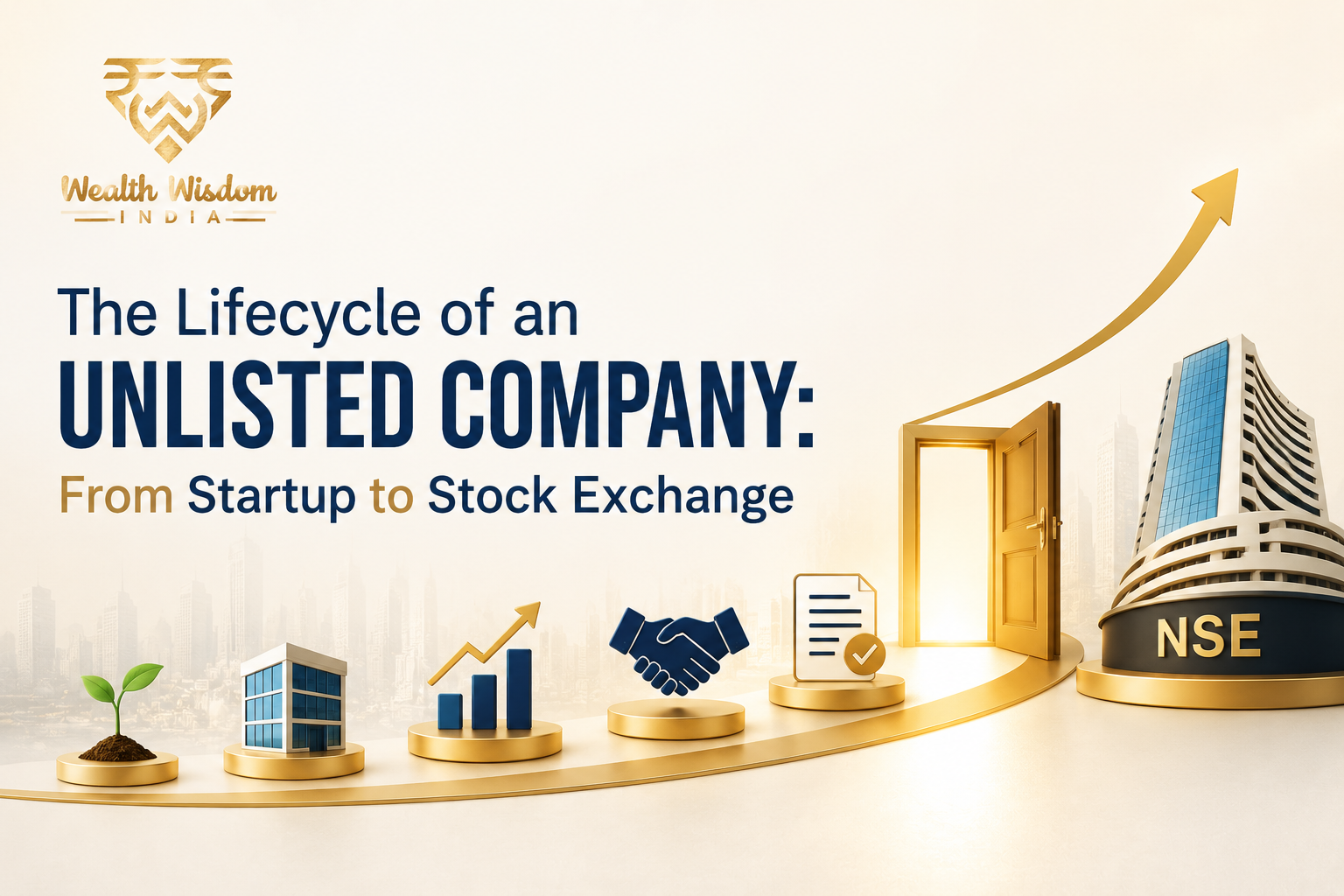
A company can spend a decade or more building its business before a single share ever changes hands on the National Stock Exchange or the Bombay Stock Exchange. Long before an initial public offering is announced, that company has already raised money, issued equity, brought in institutional backers, and built a shareholder base — all while remaining, in regulatory terms, unlisted. Becoming a listed company is not a single event that happens overnight. It is the final stage of a long process that begins with a founder’s initial capital and moves through several rounds of private ownership.
This is exactly why unlisted company shares attract attention from a certain kind of investor. Companies such as NSE and HDFC Securities have, at various points, traded actively in India’s unlisted share market long before any listing was confirmed. Understanding how a business moves from a founder’s idea to a publicly traded stock helps explain why unlisted shares exist, how they are priced, and what an investor is actually buying when they acquire them.
This article walks through that entire journey — from the startup phase to stock exchange listing — and explains where unlisted shares fit into each stage, along with the risks and practical considerations every investor should understand.
What Is an Unlisted Company?
An unlisted company is a company whose shares are not currently traded on a recognized stock exchange such as the NSE or BSE.
Such a company can still be a large, well-established business with audited financials, institutional shareholders, and hundreds of employees. What makes it “unlisted” is simply that its shares are not available for trading on a public exchange through a regular Demat and trading account in the way listed stocks are.
There are two broad categories worth distinguishing:
- A private limited company restricts the transfer of its shares and typically has a smaller number of shareholders, often founders, family members, and early investors.
- A public unlisted company is structured under company law as a public company — meaning it can have a larger and more open shareholder base — but has still not listed its shares on a stock exchange.
Unlisted equity shares represent real ownership in these businesses, the same way listed shares do. The difference lies in how they are traded, how much information is publicly available about the company, and how easily an investor can buy or sell them. Ownership before listing is usually recorded through the company’s share registry and reflected in the shareholder’s Demat account once a transfer is completed, but the process, pricing, and documentation differ meaningfully from an exchange-based trade.
Stage 1 — The Startup Phase
Every company that eventually lists on a stock exchange starts somewhere much smaller. In the startup phase, founders typically fund the business using personal savings, family capital, or small loans. As the idea gains traction, the company may raise its first outside capital from angel investors — individuals who invest in early-stage businesses in exchange for equity.
If the business shows promise, it may go on to raise seed funding, often from angel networks or early-stage venture capital funds. This capital is used to build the product, hire a founding team, and establish initial traction in the market.
At this stage, ownership is concentrated among founders and a small group of early backers. Every funding round issues new shares or converts existing instruments into equity, which changes the ownership structure of the company. A founder who owned 100% of the company at incorporation may hold a smaller percentage after two or three funding rounds, even though the value of their stake may have grown substantially in absolute terms. This process — new investors receiving shares in exchange for capital — is the foundation of how private company shares get distributed long before any public listing is contemplated.
Stage 2 — Private Funding and Expansion
As a company grows, it typically raises capital in structured rounds, commonly labeled Series A, Series B, Series C, and beyond. Each round usually involves institutional investors such as venture capital funds, private equity firms, or strategic investors — established companies that invest for business synergies rather than purely financial returns.
Several important changes happen during this stage:
- Valuation increases as the company demonstrates revenue growth, market share, or profitability.
- Dilution occurs, meaning existing shareholders’ percentage ownership decreases as new shares are issued to new investors, even though the underlying value of their holding may rise.
- Employee stock options (ESOPs) are often introduced, giving employees the right to purchase shares at a predetermined price, aligning their incentives with the company’s growth.
- Secondary transactions may begin to appear, where existing shareholders — such as early employees or early-stage investors — sell some of their shares to other investors without the company issuing new stock.
A company’s valuation can rise well before it becomes publicly listed simply because private investors are willing to pay more for equity as the business proves itself. This is also the stage where unlisted stocks first start changing hands between private parties, laying the groundwork for what later becomes a more organized unlisted share market.
Stage 3 — Becoming an Unlisted Public Company
At some point, a growing private company may convert into a public limited company under the Companies Act, 2013, even without listing on a stock exchange. This is a distinct step: private company → public unlisted company → listed company.
Converting to a public company structure typically brings a broader shareholder base, more formal governance requirements, and greater flexibility to raise capital from a wider group of investors. It does not automatically mean the company is preparing for an IPO — many public unlisted companies operate this way for years without listing.
For investors, this stage matters because Unlisted Company Shares of a public unlisted company are often more actively traded in the private market than shares of a purely private company, partly because ownership transfer tends to be less restrictive and partly because more financial information becomes available through regulatory filings.
How Investors Get Exposure to Unlisted Shares
Investors interested in exposure to a company before it lists typically access shares through a handful of established routes:
- Existing shareholders who choose to sell part of their holding.
- Employees exercising and selling ESOP shares.
- Early-stage investors — angels or early VC backers — partially exiting a position.
- Secondary-market transactions, where shares change hands off-exchange between private parties.
- Intermediary platforms, which help match buyers and sellers, handle documentation, and facilitate the transfer process.
Investors who want to Buy Unlisted Shares should understand that availability is not constant. A company’s shares may be easy to find one quarter and scarce the next, depending on how many existing holders are willing to sell and at what price. Pricing is negotiated rather than quoted continuously, as it would be on an exchange order book. Settlement and documentation — including transfer deeds, board approvals in some cases, and Demat crediting — typically take longer than a listed-market trade, which usually settles within a day or two.
It is worth emphasizing that unlisted shares are not a guaranteed or risk-free investment category. Liquidity, pricing transparency, and the pace of transfer can all differ meaningfully from what an investor experiences in the listed market, and every purchase should be evaluated on its own merits.
How Unlisted Shares Are Valued
Because there is no continuous public order book for unlisted stocks, valuation depends on a combination of company-specific and market-wide factors:
- Revenue growth and profitability trends
- Overall business model and competitive position
- Broader industry outlook
- Valuations of comparable listed companies in the same sector
- The price at which the company’s most recent funding round was completed
- Prevailing demand and supply among buyers and sellers in the private market
- Anticipated valuation at a future IPO, where relevant
- General investor sentiment toward the sector or the private market as a whole
- A liquidity discount, since unlisted shares are harder to exit quickly than listed stock
An unlisted share’s price can move quite differently from a listed stock’s price because it isn’t set by continuous trading. Instead, it moves in steps — based on the latest private transaction, a new funding round, or shifting expectations about an eventual listing. This is one reason two investors might see meaningfully different quoted prices for the same unlisted company shares within a short period.
Stage 4 — The Pre-IPO Phase
When a company begins seriously preparing to list, it enters what is commonly called the pre-IPO phase. This involves engaging merchant bankers (also called investment banks or lead managers) to structure the offering, strengthening financial disclosures, and formalizing corporate governance practices to meet exchange and regulatory expectations.
In India, this generally includes filing a Draft Red Herring Prospectus (DRHP) with the Securities and Exchange Board of India (SEBI) and, closer to the offering, a Red Herring Prospectus (RHP) that contains the finalized details of the issue. Regulatory due diligence intensifies during this period, and investor interest in the company’s pre-IPO shares typically increases as the prospect of a listing becomes more concrete.
Some investors specifically look for what they consider Best Unlisted Shares during this window, based on the strength of the underlying business, its growth trajectory, and its likely path to listing. It is important to be clear that “best” is a subjective judgment tied to an individual investor’s goals, time horizon, and risk tolerance — not an objective or guaranteed category, and past private-market performance does not indicate what will happen after listing.
Stage 5 — IPO and Stock Exchange Listing
The IPO itself marks the formal transition from unlisted to listed status. The process generally includes:
- The company and its bankers announce the IPO, including a price band.
- The issue opens for public subscription, allowing retail and institutional investors to apply for shares.
- Shares are allotted to successful applicants based on the demand and the allotment process defined for the issue.
- On listing day, the stock begins trading on the NSE and/or BSE, and its opening price is determined through price discovery based on market demand.
Once listed, several things change fundamentally for shareholders. The stock now trades continuously during market hours, with a publicly visible price that updates in real time. Regulatory disclosure requirements become far more extensive, since listed companies must comply with SEBI’s continuous disclosure norms. Liquidity typically improves sharply, since shares can now be bought or sold through any broker with a Demat and trading account, rather than through a negotiated private transaction.
What Happens to Unlisted Shareholders After an IPO?
Shareholders who held unlisted company shares before the IPO generally see their existing shares get listed alongside the newly issued shares, though the specific treatment can depend on the class of security held and the terms of the offering. A few points are worth understanding clearly:
- Price discovery on listing day can result in a stock price meaningfully above or below the IPO price band, and also above or below the price the investor originally paid in the unlisted market.
- Lock-in restrictions sometimes apply to certain categories of pre-IPO shareholders, such as promoters or anchor investors, which can restrict selling for a defined period after listing. These rules vary by the specific class of shareholder and the applicable listing regulations, so investors should verify the exact terms that apply to their holding.
- Liquidity changes substantially once shares list, since they can now be traded through the exchange rather than through private negotiation.
- Volatility can increase, at least in the short term, as a broader base of market participants begins trading the stock.
- Disclosure requirements for the company increase significantly post-listing, which generally improves the amount of public information available to shareholders.
Because rules can differ depending on the specific security, the shareholder category, and the applicable regulations at the time, investors holding pre-IPO shares should confirm the exact terms with the company, their broker, or a qualified advisor rather than assuming a single universal rule applies.
Can Investors Sell Unlisted Shares?
Yes, investors can generally sell unlisted shares, but the process is different from selling a listed stock.
Selling in the unlisted market involves finding a willing buyer — either directly, through existing networks, or through an intermediary platform that connects buyers and sellers. Pricing is negotiated based on the factors discussed earlier in this article, rather than being read off a live exchange order book. Once a price is agreed, the transaction requires transfer documentation, and the shares are moved to the buyer’s Demat account, a process that typically takes longer to settle than an on-exchange trade.
Investors looking to Sell Unlisted Shares should also be aware of any lock-in periods tied to the specific security, and should confirm applicable tax treatment before completing a transaction, since capital gains rules can differ based on the holding period and the nature of the security.
Selling unlisted equity shares differs from selling a listed stock through NSE or BSE primarily because there is no continuous market with a visible bid-ask spread. Liquidity depends on the presence of interested buyers, which can vary significantly by company and by market conditions.
Unlisted Shares vs. Listed Shares
| Factor | Unlisted Shares | Listed Shares |
| Trading venue | Private/OTC transactions, intermediary platforms | Stock exchange (NSE/BSE) |
| Liquidity | Lower, dependent on finding a counterparty | Generally higher, continuous market |
| Price discovery | Negotiated, based on recent deals and valuations | Continuous, driven by live order book |
| Transparency | Limited public disclosure | Extensive, mandated regulatory disclosures |
| Information availability | Depends on company and intermediary | Quarterly results, filings, analyst coverage |
| Regulation | Governed mainly by the Companies Act, 2013; not regulated as an exchange-traded market | Fully regulated under SEBI’s listing and disclosure framework |
| Volatility | Can be lower day-to-day due to infrequent trading, but valuation can shift sharply on news | Reflects real-time market sentiment |
| Settlement | Can take days depending on documentation | Typically T+1 for most listed equities |
| Exit options | Limited to finding buyers privately | Can sell anytime during market hours |
| Risk | Higher liquidity and valuation risk | Market risk, generally more transparent pricing |
Key Risks of Investing in Unlisted Equity Shares
Investing in unlisted equity shares carries a distinct risk profile that every investor should weigh carefully before committing capital.
- Liquidity risk: There may not always be a ready buyer when an investor wants to exit.
- Valuation risk: Prices are negotiated rather than continuously quoted, which can lead to mispricing.
- Business risk: Unlisted companies, especially younger ones, carry the same operational and competitive risks as any business, sometimes with less public scrutiny.
- IPO uncertainty: There is no guarantee that a company will list within a specific timeframe, or at all.
- Lock-in restrictions: Certain shares may be subject to holding periods that restrict when they can be sold.
- Limited information: Unlisted companies are not required to disclose as much as listed companies, making due diligence harder.
- Post-listing volatility: A stock’s price after listing can move well above or below what an investor paid in the unlisted market.
- Counterparty and transaction risk: Off-exchange transactions depend on the reliability of the intermediary and the counterparty completing the transfer correctly.
- Regulatory considerations: Rules governing unlisted and pre-IPO transactions can change, and investors should verify current requirements before transacting.
- No guaranteed listing and no guaranteed returns: An unlisted investment should never be treated as a certain path to profit.
How to Research an Unlisted Company Before Investing
A disciplined research process should cover the following areas before any unlisted share purchase:
- Revenue and profitability — trends over multiple years, not a single strong quarter
- Debt levels — how leveraged the company is relative to its peers
- Cash flow — whether operations generate real cash, not just accounting profit
- Valuation — how the asking price compares with the company’s last funding round and with listed peers
- Promoters and management — track record and reputation
- Shareholding pattern — who currently owns the company and in what proportion
- Funding history — which investors have backed the company and at what valuations
- Industry and competitors — the company’s position relative to its sector
- Corporate governance — board composition, related-party transactions, audit quality
- Potential IPO plans — whether there is a credible, disclosed timeline, or only speculation
- Liquidity and exit options — how easily the specific shares can realistically be sold
- Applicable taxes and regulations — capital gains treatment and any transfer restrictions
Treating this as a checklist rather than a formality tends to separate informed unlisted-share investors from those relying on rumor or hype.
How WWIPL Can Help Investors Explore Unlisted Shares
Wealth Wisdom India Private Limited (WWIPL) is an India-based platform, headquartered in Indore with its registered office in Mumbai, that facilitates transactions in unlisted, pre-IPO, and delisted shares. The platform connects investors looking to buy unlisted shares with existing shareholders looking to sell, and it provides company-level information intended to support an investor’s own research and due diligence.
Investors researching the private market can use a platform such as WWIPL to review a list of available unlisted company shares, check indicative pricing, and understand the documentation and Demat-transfer process involved in a transaction. WWIPL states that it does not function as a stock exchange and does not offer investment advice — its research materials are intended to help investors understand a company’s business model, not to recommend whether to buy or sell any specific security. As with any unlisted-market transaction, investors should independently verify company information, confirm current pricing, and assess the risks outlined earlier in this article before deciding to buy unlisted shares, sell unlisted shares, or hold unlisted equity shares through any platform.
If you are researching opportunities in the unlisted-share market, visit WWIPL to review available unlisted companies and learn more before making an investment decision.
Frequently Asked Questions
What is an unlisted company?
An unlisted company is a business whose shares are not traded on a recognized stock exchange such as the NSE or BSE. It can still be a substantial, well-run company with institutional investors and audited financials — the distinction is purely about how its shares are traded, not the size or quality of the business itself.
What are unlisted company shares?
Unlisted company shares represent ownership in a business that has not listed on a public stock exchange. They carry the same fundamental ownership rights as listed shares but are transferred through private or over-the-counter transactions rather than continuous exchange trading, and typically involve more negotiation and documentation.
How can I buy unlisted shares in India?
Investors can buy unlisted shares from existing shareholders, employees selling ESOP shares, early investors, or through intermediary platforms that facilitate such transactions. The process usually involves agreeing on a price, completing transfer documentation, and having the shares credited to a Demat account, which can take longer than a listed-market trade.
Can I sell unlisted shares?
Yes. Selling unlisted shares involves finding a buyer, agreeing on a price, and completing transfer paperwork, often through an intermediary platform. Unlike listed stocks, there is no continuous exchange order book, so pricing depends on negotiation, recent comparable transactions, and prevailing demand for that specific company’s shares.
Are unlisted shares risky?
Yes, unlisted shares carry distinct risks, including limited liquidity, valuation uncertainty, restricted information disclosure, and no guarantee of a future listing. They can also be affected by broader business and regulatory risks. Investors should treat them as a higher-risk category compared with listed equities and size positions accordingly.
How are unlisted shares valued?
Unlisted shares are valued using factors such as recent funding-round pricing, revenue and profitability trends, comparable listed-company valuations, industry outlook, and prevailing demand and supply among private buyers and sellers. Because there is no continuous market price, valuations can shift meaningfully between transactions.
What is the difference between unlisted and listed shares? Listed shares trade continuously on a stock exchange with transparent, real-time pricing and extensive regulatory disclosure. Unlisted shares trade through negotiated, off-exchange transactions with less frequent price updates, longer settlement timelines, and comparatively limited public disclosure about the company’s operations and financials.
What happens to unlisted shares when a company launches an IPO?
When a company completes its IPO, its previously unlisted shares generally become listed alongside newly issued shares, subject to the specific terms of the offering and any applicable lock-in restrictions for certain shareholder categories. Liquidity typically improves significantly, since the shares can then be traded on the exchange.
Are all unlisted companies expected to go public? No. Many unlisted companies, including well-established public unlisted companies, operate for years or indefinitely without listing on a stock exchange. Some prioritize control retention, avoid listing-related compliance costs, or simply have no strategic need for public capital markets access.
How do I research an unlisted company before investing?
Review the company’s revenue, profitability, debt, and cash flow trends, its valuation relative to recent funding rounds and listed peers, its promoters and shareholding pattern, funding history, competitive position, corporate governance practices, and any disclosed IPO plans. Also assess realistic liquidity and exit options before committing capital.
What are pre-IPO shares?
Pre-IPO shares are shares of a company that is actively preparing for a stock exchange listing, typically after engaging merchant bankers and beginning the regulatory filing process. Investors who buy pre-IPO shares are generally seeking exposure to a company ahead of its public listing, with the associated uncertainty of the IPO’s timing and eventual pricing.
Where can I research unlisted shares in India?
Investors can research unlisted shares through company filings, industry reports, and platforms such as WWIPL that focus specifically on the unlisted, pre-IPO, and delisted share market. Independent verification of financial details and current pricing is recommended regardless of the source used.
This article is for general educational purposes and does not constitute investment advice. Investors should conduct independent due diligence and consult a qualified financial advisor before investing. Regulatory requirements referenced in this article are subject to change; readers should verify current Companies Act provisions and, where an IPO or listed security is involved, applicable SEBI regulations, before transacting.